
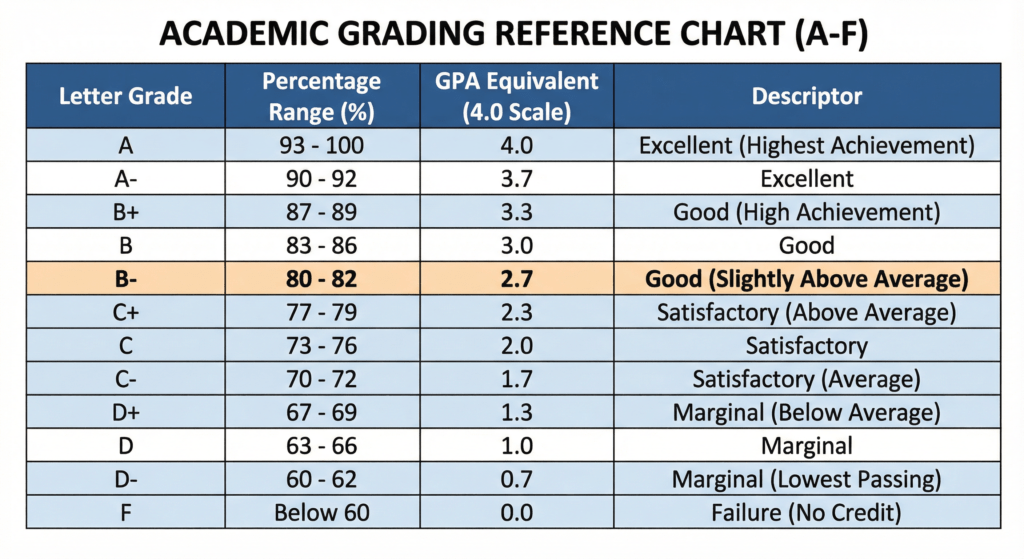
A score of 20 out of 25 equals 80%, which typically translates to a B minus letter grade on the standard grading scale. This means you answered 20 questions correctly out of 25 total questions, demonstrating solid academic performance. Whether you’re checking a test score, quiz result, or assignment grade, understanding what 20/25 means helps you track your academic progress effectively.
The Smartest Grade Calculator
Fast, Free, and Fully Featured - No Sign-up Required!
Settings
Enable partial credit in 0.5 increments (e.g., 1.5, 2.5 wrong).
Enable 0.25 increments for detailed multi-part scoring.
Show A+, A, A-, B+ instead of just A, B, C, D, F.
Celebrate perfect scores with confetti animation!
📝 Custom Grading Scale
Set minimum percentage for each grade.
What is 20/25 as a Percentage?
To convert 20 out of 25 to a percentage, divide the points earned by the total points possible, then multiply by 100. The calculation is straightforward: divide 20 by 25 to get 0.8, then multiply by 100 to reach 80%.
The formula looks like this: (20 ÷ 25) × 100 = 80%
This means scoring 20 out of 25 represents 80% accuracy or completion. You correctly answered four fifths of the questions, which demonstrates good understanding of the material with room for improvement on the remaining 20%.
Use our test grade calculator to instantly convert any score into a percentage and letter grade.
What Letter Grade is 20 out of 25?
| Letter Grade | Percentage Range |
|---|---|
| A+ | 97% – 100% |
| A | 93% – 96% |
| A- | 90% – 92% |
| B+ | 87% – 89% |
| B | 83% – 86% |
| B- ← 20/25 is here | 80% – 82% |
| C+ | 77% – 79% |
| C | 73% – 76% |
| C- | 70% – 72% |
| D+ | 67% – 69% |
| D | 63% – 66% |
| D- | 60% – 62% |
| F | Below 60% |
Complete 25-Question Grading Scale
The table below shows every possible score on a 25-question test, its percentage, letter grade, and number of questions wrong. Use it as a quick reference for any 25-point quiz or exam.
| Score | Questions Wrong | Percentage | Letter Grade |
|---|---|---|---|
| 25/25 | 0 | 100% | A+ |
| 24/25 | 1 | 96% | A |
| 23/25 | 2 | 92% | A- |
| 22/25 | 3 | 88% | B+ |
| 21/25 | 4 | 84% | B |
| 20/25 ← You are here | 5 | 80% | B- |
| 19/25 | 6 | 76% | C+ |
| 18/25 | 7 | 72% | C- |
| 17/25 | 8 | 68% | D+ |
| 16/25 | 9 | 64% | D |
| 15/25 | 10 | 60% | D- |
| 14/25 | 11 | 56% | F |
| 13/25 | 12 | 52% | F |
| 12/25 | 13 | 48% | F |
| 11/25 | 14 | 44% | F |
| 10/25 | 15 | 40% | F |
| 9/25 | 16 | 36% | F |
| 8/25 | 17 | 32% | F |
| 7/25 | 18 | 28% | F |
| 6/25 | 19 | 24% | F |
| 5/25 | 20 | 20% | F |
| 4/25 | 21 | 16% | F |
| 3/25 | 22 | 12% | F |
| 2/25 | 23 | 8% | F |
| 1/25 | 24 | 4% | F |
| 0/25 | 25 | 0% | F |
Based on the standard grading scale. Scores use plus/minus grades where applicable. Your school may use a slightly different scale.
How Does 20/25 Affect Your GPA?
A B minus letter grade typically converts to a 2.7 GPA on the standard 4.0 scale. However, the exact GPA value can vary depending on your institution’s specific conversion method. Some schools assign 2.67 to a B minus, while others might use 2.7 or even round it differently.
Understanding how individual grades affect your overall GPA helps you plan strategically for your academic goals. If you’re aiming for a certain cumulative GPA, knowing that a B minus contributes 2.7 grade points helps you calculate what grades you need in other courses.
For weighted GPA calculations, if this 20/25 score came from an honors or AP class, your school might add extra points. Honors classes often add 0.5 points, while AP or IB classes might add a full point, turning that 2.7 into 3.2 or 3.7 respectively.
Calculate your overall GPA across all courses with our GPA calculator to see how this grade impacts your academic standing.
Is 20 out of 25 a Good Grade?
Yes, 20 out of 25 is generally considered a good grade. An 80% score demonstrates that you understood and correctly applied most of the course material. You’re performing above the typical passing threshold and showing solid academic competence.
However, whether it’s good enough depends on your personal goals and circumstances. For students aiming for top tier colleges or competitive scholarships, you might want to target higher scores consistently. For others focused on understanding material and maintaining decent grades, a B minus represents solid achievement.
Understanding What You Missed
When you score 20 out of 25, you missed 5 questions or 5 points worth of material. That 20% gap represents opportunities for improvement. Understanding what you got wrong matters as much as knowing your overall score.
Review those 5 missed items carefully. Were they from one specific topic or spread across different areas? Did you make careless mistakes or genuinely not understand the concepts? Did you run out of time or misread questions?
Identifying patterns in your mistakes helps you improve future performance. If all 5 errors came from the same unit, you need focused review of that specific material. If they’re spread randomly, you might need to slow down and read more carefully. If time was an issue, you need to work on pacing strategies.
Converting Other Scores to Percentages
Understanding how to convert 20/25 helps you calculate any score. The process remains identical regardless of numbers: divide points earned by total points, multiply by 100.
For example, 18 out of 25 equals 72% (a C minus), 22 out of 25 equals 88% (a B plus), and 23 out of 25 equals 92% (an A minus). Each question on a 25 point test is worth 4%, so every correct or incorrect answer moves your percentage by that amount.
Frequently Asked Questions
What percentage is 20 out of 25?
20 out of 25 equals 80%. To calculate this, divide 20 by 25 to get 0.8, then multiply by 100 to convert to percentage form.
Is 20/25 a passing grade?
Yes, 20 out of 25 is definitely a passing grade. At 80%, it’s well above the typical 60% passing threshold and represents good academic performance.
What GPA is a 20 out of 25?
A score of 20/25 (80% or B minus) typically converts to a 2.7 GPA on the standard 4.0 scale, though exact conversions can vary by institution.
How many questions can I miss to get 20/25?
To score 20 out of 25, you can miss 5 questions. Each question on a 25 point test is worth 4% of the total grade.
What’s the difference between 20/25 and 21/25?
The difference is 4 percentage points. 20/25 equals 80% (B minus) while 21/25 equals 84% (B). That single point moves you up one letter grade level.
Can I improve my grade after scoring 20/25?
Yes, most courses include multiple assignments and exams. Strong performance on future work can raise your overall grade significantly, especially if this score came early in the term.
Calculate Your Grade Easily
Stop manually calculating percentages and letter grades. Our free grade calculators help you instantly convert any score and plan your academic success.
Use our test grade calculator to convert any score like 20/25 into percentage and letter grade instantly. Track your overall class performance with our grade calculator that handles weighted categories. Calculate what you need on finals to reach your target grade with our final grade calculator. Monitor your GPA across all courses using our GPA calculator.
These tools save time, ensure accuracy, and help you make informed decisions about your studies. Whether you scored 20 out of 25 or any other combination, get instant answers without manual calculations.
Related Grade Lookups
If you found this helpful, check out these similar grade calculations: