
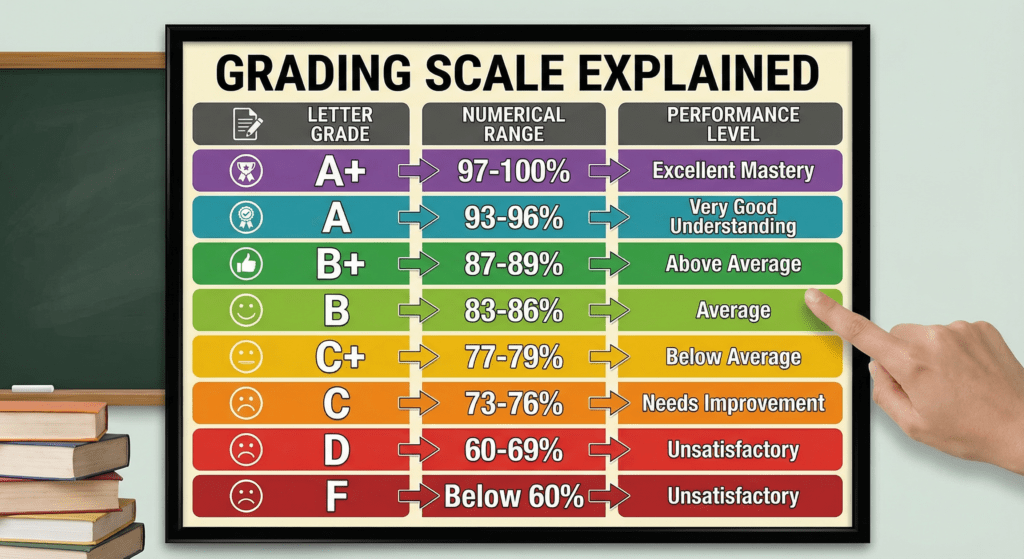
If you’ve ever wondered “what is the grading scale?” or how letter grades convert to your GPA, this guide breaks down everything you need to know. Whether you’re in high school, taking undergraduate courses, or navigating requirements as a graduate student, understanding the grading system is essential for tracking your academic progress and meeting program requirements.
What Is the Grading Scale?
The grading scale is a standardized system used by educational institutions in the United States to evaluate student performance. Most schools use letter grades (A through F) that correspond to percentage ranges and grade point values. Your final grade in each course affects your cumulative GPA, which is calculated by the Office of the Registrar and impacts everything from financial aid eligibility to satisfactory progress requirements.
Standard A-F Letter Grade System
The traditional grading system uses five primary letter grades. Here’s how they break down:
| Letter Grade | Percentage | Grade Point Value | Description |
|---|---|---|---|
| A | 90-100% | 4.0 | Excellent |
| B | 80-89% | 3.0 | Good |
| C | 70-79% | 2.0 | Satisfactory |
| D | 60-69% | 1.0 | Passing |
| F | Below 60% | 0.0 | Failing Grade |
Important: Always check your course syllabus for your instructor’s specific grading policy, as some faculty members may use slightly different scales.
Understanding Each Grade Level
A (Excellent) – Demonstrates mastery of coursework and exceeds course requirements. This higher grade positively impacts your cumulative grade point average.
B (Good) – Shows solid understanding with minor areas for improvement. Meets prerequisite requirements for most courses.
C (Satisfactory) – Represents acceptable performance that fulfills basic course requirements. Often the minimum grade needed to satisfy prerequisite requirements.
D (Passing) – Technically earns credit hours but may not meet prerequisite requirements or program standards. Many programs require students to retake courses with D grades.
F (Failing) – No credit earned. Negatively impacts cumulative GPA and requires course repetition to meet program requirements. Multiple failing grades can affect financial aid eligibility.
Plus/Minus Grading System
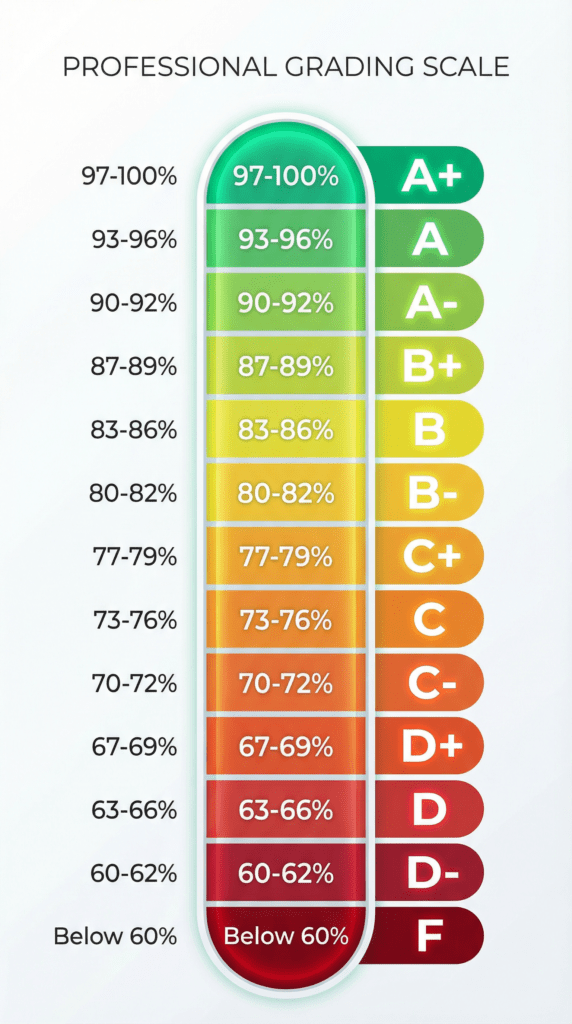
Many colleges and universities use a plus/minus system for more precise evaluation. This grading option is common in undergraduate courses and graduate student programs.
| Letter Grade | Percentage | Grade Point Value |
|---|---|---|
| A+ | 97-100% | 4.0* |
| A | 93-96% | 4.0 |
| A- | 90-92% | 3.7 |
| B+ | 87-89% | 3.3 |
| B | 83-86% | 3.0 |
| B- | 80-82% | 2.7 |
| C+ | 77-79% | 2.3 |
| C | 73-76% | 2.0 |
| C- | 70-72% | 1.7 |
| D+ | 67-69% | 1.3 |
| D | 60-62% | 1.0 |
| F | Below 60% | 0.0 |
*Some institutions award 4.3 for A+, while others cap at 4.0. Check with Student Services.
Impact on GPA Calculation
The plus/minus system uses decimal grade point values. The difference between an 89% (B+, 3.3) and 90% (A-, 3.7) is significant—0.4 points per credit hour, which adds up across multiple credit courses.
Special Grades and Notations
Beyond standard letter grades, you’ll encounter these special marks on your Student Records:
Incomplete Grade (I)
Assigned when a student cannot complete course requirements due to circumstances beyond their control. Work must be completed within the timeframe specified by academic policies (typically 6-12 months), or it converts to a failing grade.
Pass/Fail (P/F)
Some institutions allow elective courses to be taken on a credit basis using pass/fail grading. A passing grade (usually C or better) appears as “P” and doesn’t affect your cumulative grade point average. Check with the Office of the Registrar about limitations.
Withdrawal (W)
Official withdrawal from a course by the deadline. No credit earned and no GPA impact. An unofficial withdrawal may appear as “UW” and can affect financial aid.
Transfer Credit (TR)
Credit hours accepted from another institution. Usually counts toward degree requirements but may not factor into cumulative GPA calculation.
How to Calculate Your GPA
Understanding GPA calculation helps you track satisfactory progress and plan your coursework strategically.
Basic Formula
GPA = Total Grade Points ÷ Total Credit Hours
Example Calculation
| Course | Grade | Credit Hours | Grade Points | Quality Points |
|---|---|---|---|---|
| English | A- | 3 | 3.7 | 11.1 |
| Math | B+ | 4 | 3.3 | 13.2 |
| History | B | 3 | 3.0 | 9.0 |
| Biology | C+ | 4 | 2.3 | 9.2 |
Calculation:
- Multiply grade points by credit hours (Quality Points column)
- Add quality points: 11.1 + 13.2 + 9.0 + 9.2 = 42.5
- Add credit hours: 3 + 4 + 3 + 4 = 14
- GPA = 42.5 ÷ 14 = 3.04
Use our GPA calculator to compute your semester or cumulative GPA instantly.

Important Academic Policies
Minimum Grade Requirements
Different situations require different minimum grades:
- Prerequisite Requirement: Most courses require C or better (2.0+)
- Major Requirements: Typically C or better for major coursework
- Graduate Students: Usually need B- (2.7) minimum, with 3.0 cumulative average to maintain good standing
- Financial Aid: Minimum 2.0 for undergraduates, 3.0 for graduate students to maintain eligibility
Repeated Courses
When you retake a course, policies vary by institution:
- Some schools replace the old grade in GPA calculation
- Others average both attempts
- Both attempts remain on transcript
- Credit hours counted only once
- Financial aid may limit repetitions
Contact the Office of the Registrar for your school’s specific policy on repeated courses.
Grade Changes
After final grades are submitted, changes require documentation of errors. Process:
- Contact course instructor with evidence
- Instructor reviews and submits change request if warranted
- Office of the Registrar processes approved changes
High School vs. College Grading
High School:
- Often uses simpler 90-80-70-60 scale
- D typically considered passing
- Pass/fail less common
- Focus on completion
College:
- More likely to use plus/minus system
- D often doesn’t meet prerequisite requirements
- Pass/fail options available for electives
- Focus on cumulative grade point average
Strategic Grade Management
Planning Your Course Load
- Review course requirements before registration
- Check prerequisite requirements
- Balance difficult courses with manageable ones
- Consider course instructor grading policies in course syllabus
Improving Your Cumulative Average
If you need to raise your cumulative GPA:
- Focus on higher credit hour courses (more impact)
- Use our final grade calculator to see what grades you need
- Consider retaking courses with low grades
- Seek help from faculty & staff early
Understanding Your Grade Report
Your official Student Records include:
- Course grades by semester
- Credit hours per course
- Semester and cumulative GPA
- Academic standing status
- Special notations (incomplete grade, withdrawal, etc.)
International Student Considerations
International students navigating the United States grading system should know:
- The Office of the Registrar evaluates transfer credit from foreign institutions
- Grade conversions vary by school
- Foreign coursework may appear as “CR” without affecting cumulative GPA
- Maintain satisfactory progress for visa requirements
- Contact Student Services if struggling academically
Frequently Asked Questions
What’s the difference between a passing grade and satisfactory grade? A passing grade (D or above) earns credit hours. “Satisfactory” usually means C or better, which is required for most prerequisite requirements.
How do incomplete grades affect my GPA? An incomplete grade doesn’t affect cumulative GPA until resolved. It must be completed by the deadline in academic policies or converts to F.
Can I take courses pass/fail? Many schools allow this grading option for electives. Limits apply on number of credit courses and they may not count toward program requirements.
What minimum grade do graduate students need? Graduate students typically need B- (2.7) or better, with 3.0 cumulative average to maintain good standing. Requirements vary by program.
How do repeated courses appear on transcripts? Most institutions show all attempts on Student Records. GPA treatment varies—some replace the grade, others average both.
Tools for Grade Tracking
Grade Calculator – Calculate test scores instantly
GPA Calculator – Track semester and cumulative GPA
Final Grade Calculator – Determine what you need on final exams
Weighted Grade Calculator – Calculate grades with weighted categories
Final Thoughts
Understanding the grading scale is fundamental to academic success in the United States. Whether you’re tracking coursework in high school or managing program requirements in graduate school, knowing how letter grades convert to grade point values and affect your cumulative grade point average helps you make informed decisions about your student life.
For questions about your specific institution’s grading system, consult your course syllabus, the Office of the Registrar, or Student Services. Every school has unique academic policies, and understanding yours is key to maintaining satisfactory progress, financial aid eligibility, and achieving your educational goals.
Start tracking your grades today with GradeCalcPro’s free calculators and take control of your academic performance!